
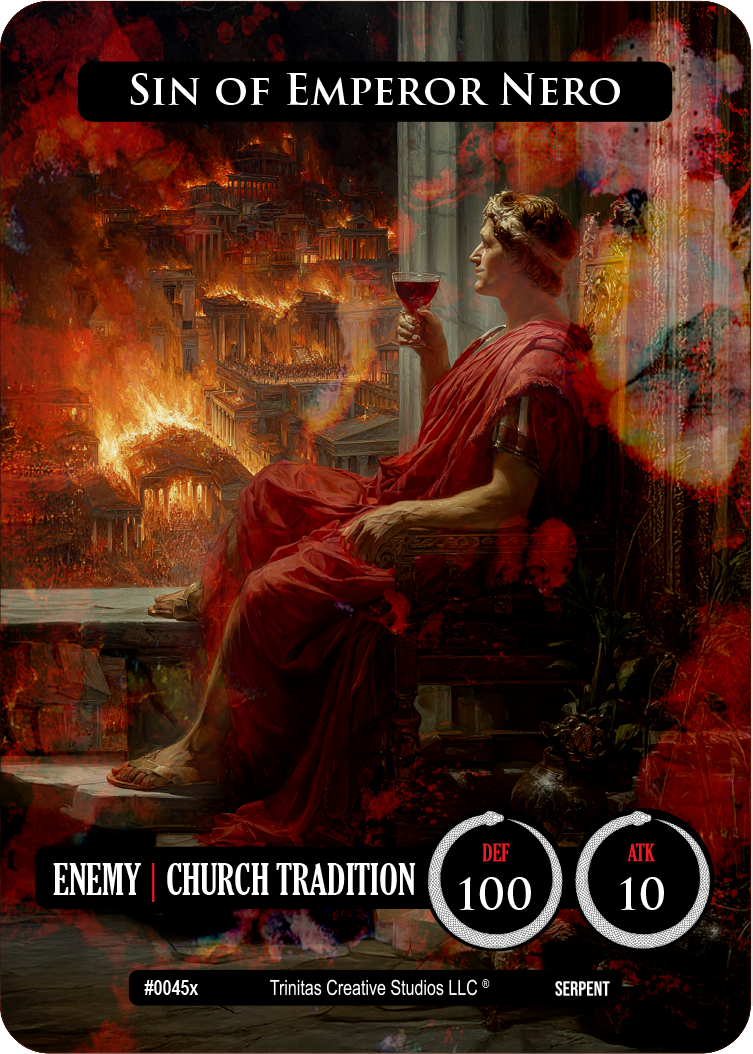
“Nero was head of the Roman Empire from A.D. 54 to A.D. 68. His persecution of the
early church after the Great Fire of Rome in AD 64 was not only an act of political
scapegoating but a grievous sin against God. In his pride and cruelty, Nero defied divine
truth by targeting followers of Christ, falsely accusing them of arson to protect his own
reputation. His actions revealed a heart hardened against God’s righteousness, as he
unleashed unimaginable brutality upon innocent believers including Saints Peter and
Paul. Christians were subjected to horrific deaths—crucifixion, being torn apart by wild
beasts, and even being burned alive as living torches to light Nero’s gardens. These
atrocities were not merely crimes against humanity; they were direct assaults on God’s
people and His kingdom. By mocking their faith and turning their suffering into public
spectacle, Nero exalted himself above God, embodying the arrogance and wickedness
condemned in Scripture. This persecution fulfilled Christ’s warning that His followers
would suffer for His name, yet it also magnified God’s glory through the steadfastness of
the martyrs. Nero’s sins stand as a sobering reminder of the rebellion of man against
God and the ultimate futility of opposing His will.
Nero’s story connects to the seven deadly sins, which Catholic teaching identifies as
root vices leading to other sins:
1. Pride – Nero’s arrogance drove him to exalt himself above all, even claiming
divine status. His pride blinded him to truth and led him to persecute God’s
people.
2. Wrath – His uncontrolled rage manifested in brutal executions of Christians,
turning their suffering into public entertainment.
3. Envy – Nero envied the growing influence of Christianity, which threatened
Rome’s pagan traditions and his own authority.
4. Greed – His desire for wealth and grandeur fueled the Great Fire rumor; he
allegedly wanted land for his lavish palace, the Domus Aurea.
5. Gluttony – Nero indulged in excessive feasts and pleasures while Rome burned
and Christians died, showing disregard for justice and compassion.
6. Lust – Historical accounts describe Nero’s immoral lifestyle, including perverse
acts that violated God’s design for purity.
7. Sloth – Instead of repenting or seeking truth, Nero chose the path of moral
laziness, scapegoating Christians rather than addressing his own corruption.”
Illustration by: Colton Rompala